OCCT v17.1 is now available in its stable release, bringing a range of improvements and updates to our tests and expanding compatibility for Linux users.
Expanding Compatibility With Linux Distributions
As part of our continued commitment to Linux, we’re expanding the range of distributions supported by OCCT.
OCCT is now compatible with distributions including Debian Buster, Red Hat 8, and other releases dating back to 2018. This makes OCCT accessible to an even wider range of Linux workstations and systems, including older configurations still in use today.
Adding IPMI Monitoring
OCCT V17.1 also introduces IPMI monitoring support on Linux, expanding our monitoring capabilities for workstations and servers.
With IPMI support, OCCT can access additional hardware sensor data provided by the system’s management controller, giving users more detailed monitoring information on workstations and servers. This feature requires either FreeIPMI or IPMItool to be installed on the system.
Because OCCT relies on these external tools to retrieve IPMI data, monitoring is subject to their own limitations. For example, if the underlying tool refreshes sensor information every seven seconds, OCCT will reflect that same refresh interval.
3D Adaptive Updated to UE 5.7
V17.1 isn’t just about Linux. We’re also updating the 3D Adaptive test to Unreal Engine 5.7.
The main reason for this upgrade is performance. The previous version of 3D Adaptive was based on Unreal Engine 5.4, which lacked some of the optimizations needed to fully stress certain GPUs. With Unreal Engine 5.7, we can more easily reach maximum GPU power on certain GPUs, while also gaining slightly finer control over the test's power curve.
For example, on our RTX 5080, the updated version of 3D Adaptive can reach 10 W more GPU power than the previous version.
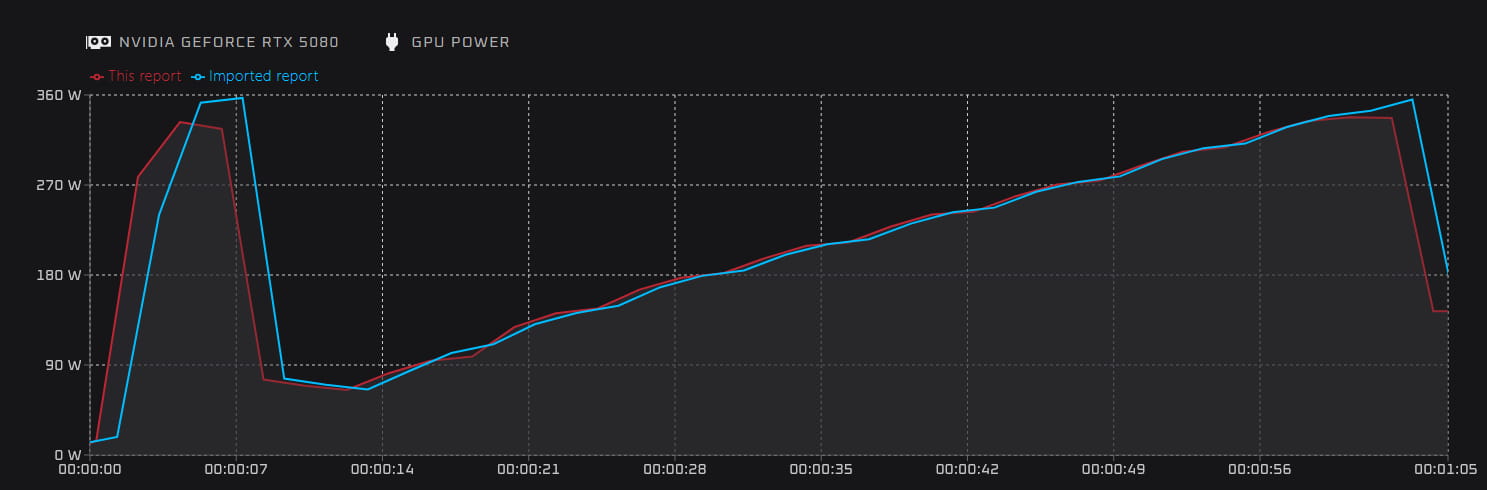
The downside is that the newer engine requires slightly more RAM to run the test. We also took this opportunity to review the Unreal Engine files in OCCT and remove unused files, freeing up around 15 MB of storage and bringing the total size of OCCT back below 200 MB.
Improved Crash Detection
OCCT V17 introduced an improved crash recovery and save-state system, providing more reliable post-crash diagnostics and preserving the latest known application state.
With V17.1, we’re taking this further based on feedback and crash reports from our users. The crash detection system has been reworked to improve how crash codes are captured and reported in the GUI, making it easier to identify failures and better understand the conditions leading to a crash or freeze.
More To Come
OCCT V17.1 continues our efforts to make OCCT more compatible, reliable, and useful across a wider range of systems.
These improvements also lay the groundwork for future updates as we continue refining the software based on user feedback. Stay tuned!