We're back with a new OCCT update, taking the work we started with v17.1 to the next level!
While most of the improvements might not be as immediately noticeable as a brand-new feature or a redesigned stress test, OCCT v17.2 packs a whole lot of optimizations into your favorite software.
In fact, this update could almost have been called v18 in terms of the work involved. But we're saving that name for something even bigger that we've been working on for quite some time!
V17.2 brings faster loading times, more efficient memory usage, improved sensor detection, and localizations. So, without further ado, let's dive in!
40% Faster, 30% Less Memory
Following an update to Reactive UI, we had to rewrite a considerable number of pipelines and update several of our underlying technical libraries. This also gave us the opportunity to carry out some major optimization work on OCCT.
We're happy to announce that compared to v17.1, OCCT now launches 40% faster and consumes 30% less RAM, bringing a more fluid, responsive, and efficient experience!
Improved 3D Adaptive
We've refined our detection algorithm, making OCCT's 3D Adaptive test even more effective at identifying stability issues, including more subtle and specific errors.
Improved Sensor Detection Runtime
Some hardware components might not be active when a test starts, which previously resulted in missing sensor information. Thanks to an update to HWiNFO, OCCT can now dynamically detect and add these sensors as soon as they become available, while running.
This is particularly useful for systems using NVIDIA Optimus technology. In some cases, the system keeps the dedicated GPU powered off until a test starts. This meant we couldn't display the dedicated GPU's sensors as it was not active. Now, as soon as the GPU starts processing, its sensors are automatically added to the monitoring section.
This improvement is also particularly interesting for some professional systems using IPMI. On these platforms, limited communication bus bandwidth can make sensor discovery a lengthy process. Sensors that weren't detected during OCCT's initial startup could previously remain unavailable.
With this update, OCCT can now discover and display these sensors dynamically, providing you with more complete and accurate monitoring data throughout your tests.
Localizations
Localizations are making a comeback in v17.2!
This feature was previously maintained through community contributions but was dropped to simplify the update process. However, we wanted to bring back the ability to use OCCT in your preferred language.
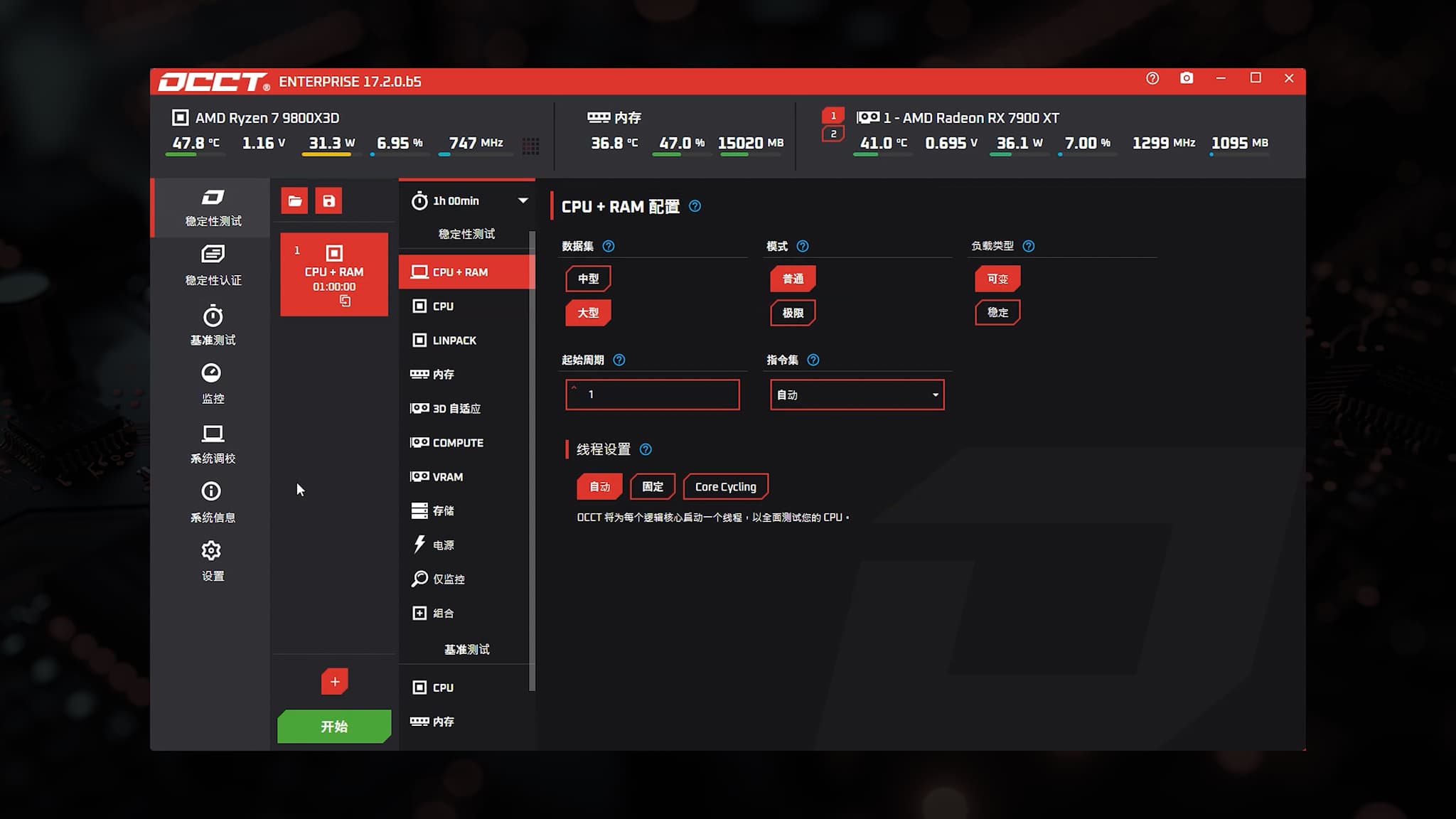
For now, we've selected a few languages and OCCT is available in English, French, German, Spanish, Chinese, and Japanese.. More languages will come in future updates.
If you spot any errors or inaccuracies, please feel free to let us know through our contact form or on our Discord server.
Coming Next
As mentioned in the introduction, we're already working on v18, and we can't wait to share more about it with you! But now isn't the time just yet. V17.2 is an important step towards what's coming next, and once we've made sure everything is working as intended, we'll be ready to share more about v18.
Thank you for using OCCT! As always, please let us know if you encounter any bugs or have suggestions for improvement.
Stay tuned for the next update!